Se afișează postările cu eticheta dadaism. Afișați toate postările

luni, 12 septembrie 2016

Lucian Muntean - "Povestile Zidurilor"


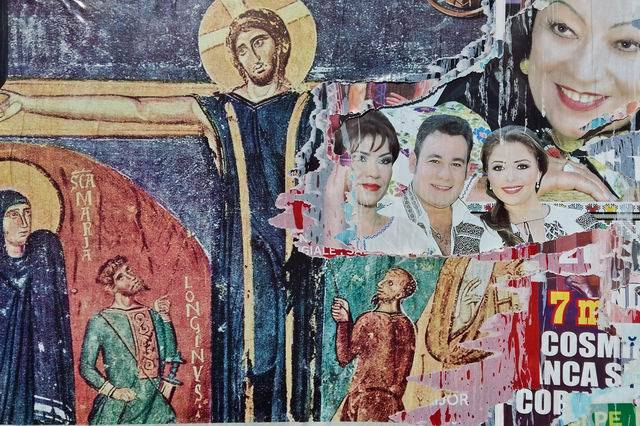
   Zidurile Bucureștiului oferă trecătorilor o expoziție permanentă de colaje. În 2016, la sarbatorirea a 100 de ani de DADA, aceste colaje se încadrează perfect în spiritul curentului. Instantaneele lui Lucian Muntean trasmit mesaje cu totul neașteptate și prezintă asocieri inedite de imagini, create involuntar prin deteriorarea afișelor, care au fost lipite succesiv pe panouri sau pe ziduri. Brusc ele  funcționeaza ca o memorie recentă a evenimentelor culturale desfășurate în Bucuresti și prezintă totodată diversitatea de genuri sau vedete preferate de public.  "Poveștile zidurilor"  o serie de fotografii făcute fără nicio altă intervenție, a afișelor jupuite sau spălate de ploi. Acest demers artistic e o preocupare a artistului, care se concretizează în decursul ultimului an. Cu toate că de fapt sunt un exemplu de poluare urbană, aceste colaje au un farmec aparte.
   Lucian Muntean este un fotojurnalist cunoscut, un pasionat al imaginii foto dar si pictura. A expus in galerii prestigioase, a participat la bienale de arta iar expozitia de la ArtXpert vine imediat dupa cea de la Berlin unde “Povestile Zidurilor” bucurestene s-au aratat publicului german.
Fotografia lui Lucian Muntean e usor descifrabila, nu e sofisticata, ceea ce o face placuta si pe intelesul tuturor, probabil ca mesria de fotojurnalist nu ii ”permite” sa se disocieze de rutina. Insa acesta rutina e frumoasa si sincera, nu cauta senzationalul ci doar face o expunere corecta a ceea ce vede, la rece, fara interventii.
Povestea zidurilor e un exercitiu, o documentare de jurnalist. Ea vine ca o proiectie recenta a intamplarilor efemere intr-un oras brutalizat de un panotaj stradal haotic. Ce e interesant si surprinzator in aceasta expozitie vine chiar de suprapunerea de layere din imagini, numai ca ce a facut providenta si intamplarea, accidental, e unic, nu implica photoshop sau nicio alta unealta digitala. Pana la urma imaginile lui Lucian Muntean s-ar descrie ca fiind un “Photoshop natural”.
   In perioada 24septembrie - 8 octombrie, galeria ArtXpert va invita la expozitia lui Lucian Muntean "Povestile Zidurilor". Vernisajul va avea loc vineri 30 septembrie orele 19.




vineri, 7 septembrie 2012

Before Being American, Pop Art Was a Romanian Business


Back in the day, when I started to paint in a pop art manner, I had to face some reaction from few fellow American artist. The concern was based upon two issues_ one being that, as a Romanian born and naturalized too late in the US, I might have no reasons, and no background, to work in this manner and, second, that out of my cultural background and national heritage there are no recognizable personalities, facts or products.

Even today I have to fight, from time to time, this two issues.

Here is my take:

"As we all know, pop art was initially considered a revision of Dadaism or neo-dada. In that take I have to remind  to all, that Dadaism is a movement that was jump-started by Romanian writer Tristan Tzara and the Romania painter Marcel Janco. “Dada was born out of negative reaction to the horrors of World War I. This international movement was begun by a group of artists and poets associated with the Cabaret Voltaire in Zurich. Dada rejected reason and logic, prizing nonsense, irrationality and intuition. The origin of the name Dada is unclear; some believe that it is a nonsensical word. Others maintain that it originates from the Romanian artists Tristan Tzara and Marcel Janco's frequent use of the words da, da, meaning yes, yes in the Romanian language. Another theory says that the name "Dada" came during a meeting of the group when a paper knife stuck into a French-German dictionary happened to point to 'dada', a French word for 'hobbyhorse'” (source Wikipedia).

On another hand, even the dealers that put pop-art on the map, ware linked to Romania:

Leo Castelli, in 1932,  went to work for an insurance company in Bucharest, where he married Ileana Schapira one year later. Ileana Schapira later changed her name and became Ileana Sonnabend nicknamed as Machiavelli, owner on Sonnabend Gallery in SoHo where along her first husband Leo Castelli influenced the art-world and put pop art on the scene.

On the regard of my Romanian iconic heritage I can only name few things, strong enough for an ex-communist country of 22 million: Constantin Brancusi, Nicolae Ceausescu (the last European dictator) and the famous “People’s House” ( the largest building in Europe).

My deep concern, as an artist, is not how other pop artists think about me, but the fact that young Romanian artists do not feel entitled to take the challenge on the pop art  aestetics. " - Eugene Al Pann